On July 11th, the State Council State-owned Assets Supervision and Administration Commission (SASAC) announced the list of A-level enterprises whose business performance was evaluated by the heads of central enterprises in 2016.
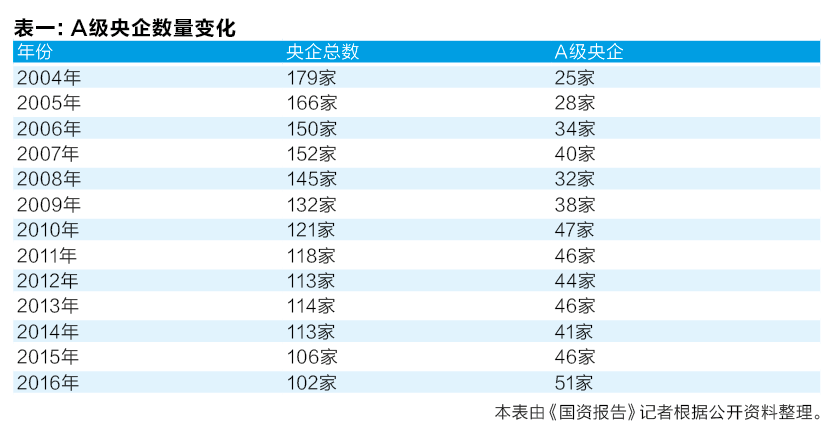
The "State-owned Assets Report" reporter noted that there were 51 A-level enterprises in 2016, accounting for half of the total number of central enterprises, and the proportion reached the highest in history. In 2015, among the 106 central enterprises, there were 46 A-level enterprises. Among the 179 central enterprises in 2004, there were only 25 A-level central enterprises. See Table 1 for details:
As can be seen from the table, due to the fluctuation of the economic situation, the number of A-level central enterprises decreased significantly in 2008, and also decreased slightly in 2012 and 2014. But overall, the proportion of A-level central enterprises is increasing year by year.
In addition, in 2016, there were 42 B-level central enterprises, and the proportion of A and B enterprises was around 90%. There are 9 C-level central enterprises and no D-level central enterprises.
These two changes can be explained from the side, since the establishment of the State Council SASAC, the development quality of central enterprises has improved steadily, the management level has improved obviously, and a team of enterprises that can represent the country to participate in international competition has gradually taken shape.
Enterprises in the military, energy and construction industries account for a relatively high proportion.
From the perspective of industry distribution, among the A-level central enterprises in 2016, a large number of enterprises were selected in the military, energy and construction industries.
Of the 11 military enterprises, except China Hangfa, which was just established and did not participate in this appraisal, eight were selected, including aerospace science and technology and aerospace science and technology, while China Nuclear Construction and China Shipbuilding Industry were not selected.
There are the largest number of energy central enterprises, including State Grid, China Southern Power Grid, five major power enterprises, Three Gorges Group, and three barrels of oil, Shenhua, China Guangdong Nuclear Power Corporation and China Aviation Oil, which belong to energy enterprises in a broad sense. Among them, China Huaneng ranked 51st.
Of course, this may be related to the large number of these two types of enterprises. However, judging from the proportion of selected enterprises, these two types of enterprises are still the echelon that can produce the best students.
However, you don’t have to work hard the day after tomorrow if you are born well. In the past 13 years, the energy industry has experienced many vicissitudes, and many enterprises have been in and out. Only the State Grid has never faded out.
In recent years, infrastructure construction in China has blossomed everywhere, which has also promoted the rapid development of central enterprises in construction. China Construction, China Communications Group, China Railway Construction, China Railway and China Power Construction were all selected as this year’s A-level enterprises.
Among the three major telecom operators, China Mobile and China Telecom were selected. Among them, China Mobile was the profit champion of central enterprises in 2016, while A-level central enterprises ranked third.
Looking through the list of A-level central enterprises over the years, we can see that China Mobile has always been in the top position, ranking first in 2008, 2010 and 2011, ranking last in 2004 (19th), and most of other years are among the top three.
In the past 13 years, the same ranking has been the State Grid.
Among the selected enterprises this year, the smallest one may be Wuhan Academy of Posts and Telecommunications, a scientific research institute. This is also the only state-owned enterprise selected as a research institute.
Among the selected enterprises, China General Technology (Group) Holding Co., Ltd. has the longest name. This is also one of the most low-key central enterprises.
Most newly reorganized central enterprises were selected.
In the past two years, the restructuring between central enterprises has continued. What is the effect of restructuring? Some clues can also be seen in this year’s list of A-level central enterprises.
Enterprises reorganized in recent two years, such as SINOMACH, COSCO Shipping, COFCO, China Baowu, China Power Investment Corporation and China Building Materials, are all on this list.
Affected by the overcapacity in the steel industry, WISCO bid farewell to A-level central enterprises after 2007, and then it was difficult to operate for years. In 2015, Baosteel Group, which was selected as an A-level enterprise for many years, also fell out of the list. China Baowu lost more than 10 billion yuan before its establishment.
By the end of 2016, China Baowu achieved a profit of 7.02 billion yuan and re-entered the list of A-level central enterprises. In the first half of 2017, the company’s profit has reached 8.66 billion yuan, an increase of nearly 100%.
The experience of COSCO Shipping is similar to this. From 2004 to 2007, COSCO Group was selected for four consecutive years, among which three years ranked among the top ten. During this period, China Shipping Group also made the list three times. After 2008, influenced by many factors, COSCO Group suffered huge losses. Except for a short recovery in 2010 and entering 28 A-level central enterprises, it has disappeared from the list.
After the merger in early 2016, COSCO Shipping entered a new era, with a profit of 16 billion yuan in that year, and returned to the list of A-level central enterprises that have been away for many years, ranking 37. In the first half of 2017, the profit exceeded 10 billion yuan. If there are no accidents, its ranking among A-level central enterprises will continue to improve in 2017.
China CRRC, which reorganized relatively early, ranked eighth among A-level enterprises in 2016.
It can be seen that for industries with overcapacity or export-oriented industries, restructuring and integration are indeed conducive to the steady improvement of the strength of central enterprises.
The change of A-level list witnessed the structural adjustment and the development level of central enterprises improved.
In the 13 years since SASAC began to assess central enterprises, China’s economy has experienced great changes from high-speed growth to short-term decline during the world financial crisis, and then to the new economic normal, and China’s economic structure has also undergone earth-shaking changes.
The fate of the central enterprises mainly distributed in the real economy has also changed greatly in this process. The list of A-level central enterprises in the past 13 years has become the epitome of this change.
The reporters of State-owned Assets Report found that before 2012, China Petrochemical had been ranked among the top three A-level central enterprises for 8 years. China Petroleum has accumulated for seven years. Among them, China Petroleum did not enter the A-level central enterprises in 2005, and the two enterprises ranked lower in 2008. Since 2013, China Petrochemical has not entered the top ten.
In contrast, China CNOOC ranked second in 2010 and 2011, and ranked first in 2013 and 2014. In 2015 and 2016, it fell to 21 and 40 respectively.
Before 2007, WISCO and Angang were listed four times respectively, and now Angang has disappeared for many years; After the reorganization of WISCO and Baosteel, it appeared in this list again.
Chinalco, which belongs to the metallurgical industry, was listed four times before 2008, ranking the top five. Has not yet returned.
On the contrary, China Merchants and SDIC, which have been A-level for 13 years in a row, were not ranked high in the initial stage of assessment, but their performance was very stable. In the latest assessment, they both ranked among the top ten.
From Table 2, it is not difficult to find that the top ten A-level central enterprises in 2004, except military enterprises, are basically concentrated in areas with heavy assets and strong dependence on resources such as oil, coal and metallurgy.
The top ten in 2016 included two central military enterprises; Three central enterprises with diversified industries and typical characteristics of investment companies (China Merchants, SDIC and China Resources); As well as power grid, communication, equipment manufacturing and a construction central enterprise.
It is worth mentioning that most of today’s national business cards are produced by these 10 central enterprises. For example, China CRRC’s high-speed rail; Smart grid of State Grid; Manned space series products; 5G technology and so on.
The investment ability and level of China Merchants and SDIC, as well as their performance in the new round of state-owned enterprise reform, have also made them important targets for many enterprises to learn and become model enterprises in the pilot process of SASAC Capital Investment Company.
It can be seen that innovation ability and transformation consciousness have become the most important characteristics of today’s A-level enterprises.
Eight central enterprises have been awarded Grade A for 13 consecutive years, and the incentive effect is obvious.
In the past 13 years since the State-owned Assets Supervision and Administration Commission (SASAC) assessed central enterprises, eight central enterprises have successively obtained A-level. They are Aerospace Science and Technology, Ordnance Industry, China Electric Branch, State Grid, CNOOC, China Mobile, China Merchants Group and SDIC.
No matter how the market ups and downs, these enterprises have always maintained a good momentum of development, and there have been no major accidents, whether safety accidents or other problems.
Among the 8 13A central enterprises, there are 3 military central enterprises, and others are distributed in different industries. In terms of scale, except for the total revenue of SDIC, which is less than 100 billion yuan, others are big. However, the profit margin of SDIC is very impressive: in 2016, the revenue was 98.4 billion yuan and the profit was 18 billion yuan, a year-on-year increase of 9%; The economic added value was 6.1 billion yuan, a year-on-year increase of 20%.
Except China Merchants and SDIC, the other six 13A enterprises are all members of the world’s top 500, and their rankings are relatively high.
According to the size of China Merchants, it can get a good ranking among the world’s top 500, but because its holding China Merchants Bank participated in the ranking of the world’s top 500, China Merchants did not participate in this selection. According to the previous statement, China Merchants intends to build itself into the cradle of "the world’s top 500".
In this year’s list of A-level central enterprises, the top seven are all 13A central enterprises except China Resources. In addition, the weapon industry of central enterprises in 13A ranks 17th, while CNOOC ranks 40th, which is significantly lower than previous years.
For this achievement, the leaders of relevant central enterprises and their cadres and workers attach great importance to it.
The reporter of "State-owned Assets Report" learned that on the 6th day after the announcement of the grade A of the 13th Company, China Electric Power Department held a working meeting to summarize the grade, analyze the situation and deploy tasks. Xiong Qunli, chairman of China Electric Power Branch, said that the honor of "13 Company A" is hard-won and precious, which is the affirmation of the State Council State-owned Assets Supervision and Administration Commission on China Electric Power Branch’s unremitting efforts in the fields of national defense modernization and national economic informatization construction in recent years, and also the result of the hard work of the cadres and employees under the strong leadership of the party group of the group company.
Wang Huisheng, chairman and party secretary of SDIC, said that SDIC people were not complacent in the face of honor, tireless in the face of achievements, and not discouraged in the face of difficulties before they won this honor. At the same time, he reminded that "born in sorrow, died in happiness." Wang Huisheng demanded that we should not be arrogant and impetuous in the face of achievements, and continue to "keep the vigor of being brave in reform, persist in the spirit of constant innovation, uphold the courage of breaking the old and creating new ones, and carry forward the upright spirit of being clean and honest" and "keep the original heart unchanged and move forward with determination".
What are the reasons why a group of central enterprises have the genes of lasting success?
In this year’s list of A-level central enterprises, several of them are accumulated for 12 years. For example, CNNC is A-level every year except in 2004; China Resources lost the election once in 2013; CCCC was reorganized and established in 2005, and did not participate in the first selection.
Guodian Group was also selected as A-level central enterprises for a total of 12 years-2008. Due to the influence of the big environment, the top five power generation companies collectively fell out of the list.
Therefore, in order to avoid the impact of accidental factors on the assessment results, the SASAC also carried out a three-year term assessment, which can be simply understood as taking the three-year average assessment. As of 2016, there were four term assessments. Eighteen state-owned enterprises have been awarded Grade A for four consecutive terms. In addition to the above eight, there are also China National Nuclear Corporation, AVIC, CSIC, China Petroleum, China Petrochemical, China Construction, Guodian Group, Huaneng Group, China Resources Group and China Communications Group.
These 18 central enterprises can be called the top students who play a stable role in the team of central enterprises, and they have fully possessed the genes of long-lasting foundation.
In addition, the reporter found that the central enterprises that have been listed for more than 10 times include Shenhua Group (11 times), China Southern Power Grid (11 times), weapons and equipment (11 times), aerospace science and technology (10 times) and Three Gorges Group (10 times).
Of course, in addition, some central enterprises failed to participate in the evaluation of A-level central enterprises in previous years because of their late establishment or late transfer to SASAC. But in fact, they are also fully capable of competing with these 18 central enterprises.
Among these 18 central enterprises, except CCCC, which is the main person in charge of the management of SASAC, the other 17 are the central enterprises which are the main person in charge of the management of the Central Organization Department, that is, the so-called "deputy ministerial level" central enterprises. Including those who have been more than 10 times in a row, most of them are central enterprises of this camp.
The above-mentioned central enterprises, which have the genes of lasting success, are distributed in the fields of military industry, energy, construction, investment and so on. How did they sit on the Diaoyutai steadily in the ups and downs?
The sentiments of various central enterprises may be different. However, among the 13A central enterprises, the experiences of SDIC and China Merchants are worth mentioning.
As two central enterprises based on fully competitive industries, these two enterprises were basically located at the end of the A-level central enterprise team at the initial stage of the assessment of the SASAC. However, in recent years, these two enterprises have always maintained a high-speed development trend, ranking forward among A-level central enterprises. This year, they have both ranked among the top ten.
First of all, it was not a day’s work to achieve this achievement. Wang Huisheng analyzed that this is inseparable from the continuous accumulation since the establishment of SDIC and the long-term efforts of a group of veteran comrades of SDIC.
"Secondly, SDIC has never been complacent and has always been unable to find enough." Wang Huisheng said that in practice, it should benefit from the four concepts that SDIC has always adhered to: advanced strategy, effective management, reasonable structure and people-oriented. "Being ahead of strategy is what I am most proud of. Most of the grand strategies of SDIC in these years coincide with the requirements of the state "(for details, see the cover report of the 12 th issue of the State-owned Assets Report in 2016).
Li Jianhong, Chairman of China Merchants Group, learned from steady and balanced development. "The ship of China Merchants is getting bigger and bigger, with large volume, great influence and great inertia. To drive this ship, we must first be stable." "Doing a good job in risk control is more important than making money in the short term".
Li Xiaopeng, general manager of China Merchants, added, "We must never lose the fundamentals of internal management in the rapid development."
The reporter of "State-owned Assets Report" learned that for more than a decade, China Merchants has always strictly controlled the debt ratio, and determined that the overall debt should not exceed 60% and the interest-bearing debt ratio should not exceed 40% (the "State-owned Assets Report" will launch an in-depth report in the near future to reveal the legend of China Merchants).
Be steady and far-reaching It is this kind of risk awareness of treading on thin ice and approaching the abyss that has enabled SDIC and China Merchants to maintain a strong determination in the face of various challenges, and enterprises have always been driving on a healthy channel.
Of course, only risk awareness is far from making the enterprise last forever. The enterprising spirit and ability of reform and innovation are also very important.
Take China Electric Power Branch as an example. This military central enterprise, which is relatively unfamiliar to the public, has continuously promoted the transformation of its thinking mode, organization mode and working mode for many years, and has formed five major formats: military electronics, civilian products industry, international operation, scientific and technological innovation, asset management and capital operation, and its total profit ranks in the forefront of military central enterprises.
On this basis, Xiong Qunli put forward that "innovation is the source power and survival way of the development of China Electric Power Department, and only by continuously deepening reform can we continuously stimulate our own vitality." He believes that only by persisting in reform and innovation can we "ensure that we will continue to obtain A-level unshakable in the performance evaluation of central enterprises of SASAC".
Of course, there are many reasons for the success of enterprises with a long history, and it is difficult to describe them in a few words. To this end, the "State-owned Assets Report" will successively launch a series of reports on the "evergreen foundation" of central enterprises, so please pay attention. (State-owned assets reporter Liu Qingshan)