[A Written Talk on Education along the Direction of the 20th Party Congress]
Authors: Zhao Jingjing and Qin Jianqun (Associate Research Fellows of China Academy of Educational Sciences and Associate Professor of School of Economics, Hebei University).
Report to the 20th CPC National Congress of the Communist Party of China clearly pointed out that it is necessary to build a coordinated development pattern of large, medium and small cities based on urban agglomerations and metropolitan areas. Land planning with urban agglomeration as the main unit is an important regional development strategy in China at this stage. In the final analysis, the sustainable and healthy development of urban agglomerations depends on the continuous kinetic energy provided by a reasonable structure and sufficient talent team. Vocational colleges are the main body of training technical and technical talents at all levels, and they are also one of the main participants in the optimization of economic spatial pattern. At present, the overall layout of China’s vocational education lacks the vision of urban agglomeration planning. Although the urban agglomeration is geographically close and culturally close, the ecological difference of vocational education is great, and the difficulty of collaborative governance cannot be ignored. Therefore, how to serve the development of cities with different quantity, nature, type and scale in a specific geographical area and how to adjust the spatial layout more effectively is an important topic in the reform and development of vocational education in China.
Urban agglomeration is a new direction for vocational education to serve regional economic development.
Vocational education serving urban agglomeration is the realistic embodiment of its natural attribute. General Secretary of the Supreme Leader pointed out that high-quality development is the primary task for the whole people to build a socialist modern country. Vocational education has a clear spatial orientation and strong adaptability, and vocational education that does not adapt to regional development cannot be called high-quality vocational education. As a large developing country, China’s spatial economic structure has gradually evolved, and urban agglomeration has become the main form of regional economic and social development in China. The rapid development of urban agglomeration can not be separated from the input of human capital elements. In recent years, the growing shortage of technical and skilled personnel has highlighted the importance of vocational education. Taking urban agglomeration as the basic unit to analyze the layout of vocational education will find new ideas and new perspectives for the reform and development of vocational education.
The layout of vocational education based on urban agglomeration aims at "exchanging space for time". The endowment of vocational education resources is relatively limited, and once the investment is determined, it is difficult to change quickly in a short period of time, objectively it is difficult to flexibly meet the industrial demand, and the contradiction between the relatively stable supply of vocational education and the dynamically changing industrial demand is not easy to reconcile. The characteristics of urban agglomeration and its unique spatial expansion function can break the geographical restrictions of vocational education personnel training. Taking urban agglomeration as a unit to plan the layout of vocational education will expand the development planning confined to urban agglomeration, which not only expands the service scope of technical and skilled personnel, but also expands the geographical scope of integration of production and education, which can effectively alleviate the contradiction between the lag of technical and skilled personnel training and the rapid industrial renewal iteration.
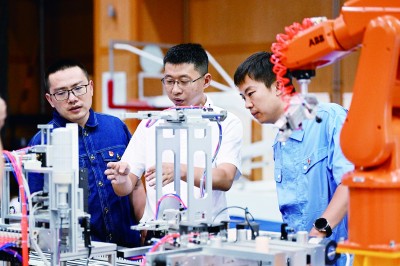
Tianjin Institute of Mechanical and Electrical Technology. Xinhua news agency
At present, at the important historical stage of the formation of China’s spatial economic structure, population and industry have further gathered in urban agglomerations. Nineteen urban agglomerations have gathered 75% of the population with 25% of the country’s land, creating 88% of the total GDP. Urban agglomeration breaks the inherent boundaries of traditional administrative divisions, and the layout of productive forces is based on the degree of industrial correlation and internal relations of industries. Industrial division of labor, industrial upgrading and industrial transfer occur all the time inside and outside urban agglomeration. The layout of vocational education with provincial and prefecture-level regions as the main planning units has the disadvantages of over-reliance on administrative geographical division and neglect of economic division, which can no longer meet the new spatial economic form and the individual development needs of students in reality. Relevant theories such as the focus theory of urban agglomeration, industrial location theory and labor market segmentation have directly or indirectly confirmed that the reasonable layout of vocational education has a boosting effect on the construction of urban agglomeration. With the development of urban agglomeration, vocational education has also ushered in a good opportunity for optimization and adjustment.
The spatial form of vocational education in China’s urban agglomerations needs to be optimized
Urban agglomeration is the main position to promote the high-quality development of vocational education, and it is often a gathering place for problems and contradictions. Taking urban agglomeration as the basic unit to explore the spatial layout of vocational education can accurately summarize the characteristics, find problems and then solve them.
By measuring the data collected from the supervision and evaluation of vocational education, it is found that the spatial layout of vocational education in urban agglomerations in China has the following main characteristics:
The overall spatial form is initially formed, and the imbalance phenomenon is more prominent. In China’s urban agglomerations, the scale of secondary vocational education is positively related to the population. As the urban agglomeration with the largest resident population, the number of secondary vocational schools ranks first. The distribution of higher vocational schools (in this paper, the specialist level) is highly related to the economic level and concentrated in developed urban agglomerations. However, the per capita possession of vocational education resources in developed urban agglomerations is still obviously insufficient.
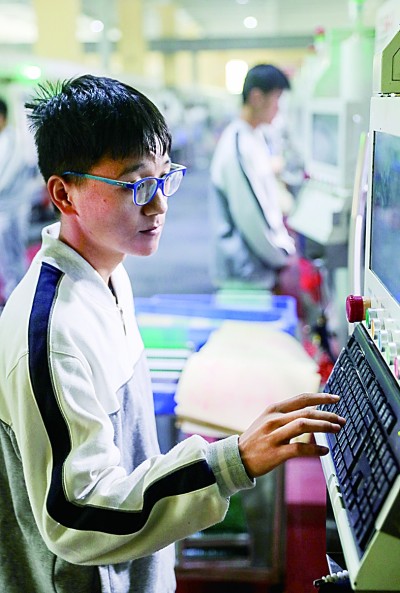
Tianjin Institute of Mechanical and Electrical Technology. Xinhua news agency
The radiation range and intensity of the central city are not enough, and the siphon effect is gradually increasing. Most of the central cities of urban agglomerations have insufficient radiation driving capacity, and the overall distribution of high-quality resources is unbalanced. Except for the Yangtze River Delta, the high-quality resources of vocational education in other urban agglomerations are excessively concentrated in provincial capitals and central cities. Take Guangdong-Hong Kong-Macao Greater Bay Area as an example. Among the nine cities in Greater Bay Area, five have "double-high" vocational schools, while Guangzhou has 9, and there are 10 national demonstration vocational schools in the city, with no more than 5 in other cities. With the intensification of internal and external talent flow in urban agglomerations, the resources of high-quality teachers tend to be further concentrated in central cities and developed urban agglomerations, and the resources of teachers in secondary cities are seriously lost, especially in developed urban agglomerations, which leads to some schools losing their enthusiasm for cultivating excellent teachers and solidifying and deepening the uneven allocation of resources to some extent.
The degree of matching between specialty setting and market is not high, and the outflow of graduates from some urban agglomerations is serious. In addition to the Beijing-Tianjin-Hebei and Lanxi urban agglomerations, the professional settings of vocational colleges in other urban agglomerations are more concentrated on the tertiary industry-related majors with relatively low training costs and which students are more willing to accept. The proportion of tertiary industry employees in Chengdu-Chongqing, Yangtze River Delta, middle reaches of Yangtze River and Central Plains urban agglomerations is much lower than that of tertiary industry majors in higher vocational schools. Urban agglomerations with a good industrial base maintain a high employment rate, and some economically backward urban agglomerations have a serious brain drain.
The development of vocational education has its own characteristics and advantages, lacking internal and external cooperation of urban agglomeration. The Yangtze River Delta, Guangdong-Hong Kong-Macao Greater Bay Area and other urban agglomerations show a high degree of marketization, and the solid industrial base provides strong support for vocational education. The number of school-enterprise cooperation and the number of off-campus practice training bases per school are far ahead, and the social training funds have been rising year after year. The part of higher vocational funds that comes from industrial enterprises accounts for more than 10%. Although the industrial base of Lanxi and Chengdu-Chongqing urban agglomerations is relatively weak, vocational education has been highly valued by government departments, and the local financial investment is relatively large. The enterprises’ efforts to provide practical instruments and equipment for higher vocational schools are higher than the national average. However, on the whole, although the urban agglomerations are geographically close and culturally friendly, there are great differences in vocational education ecology. The resources between urban agglomerations and within urban agglomerations are seriously divided, and the win-win cooperation mechanism has not yet been established, lacking long-term cooperation will and planning.
Clear the path of optimizing the spatial layout of vocational education in urban agglomerations and clarify the complex relationship network.
Urban agglomeration is a complex evolutionary system. To clarify the optimal governance path of vocational education layout in urban agglomeration, we must deal with the relations between competition and cooperation, fairness and efficiency, whole and part, stability and dynamics. It is suggested to start with the following aspects:
Establish a governance framework for vocational education circles and establish an authoritative coordination body. Judging from the existing spatial form of vocational education in China, the central city plays a leading role, and the high-quality vocational education resources in the central city drive the development of the surrounding areas, which conforms to the basic principle of regional unbalanced development. It is necessary to take the central city as the origin, build a distinctive and differentiated governance framework for vocational education circles, make full use of the centripetal nature of vocational education in urban agglomerations, and explore the formation of a functional hierarchical differentiation pattern.
Explore the spatial value of urban agglomerations from multiple angles and effectively release the "spatial dividend". The outward expansion of urban circles shows the characteristics of periodic fluctuation, and at this time, there are often opportunities for the development of new and old industries to update and iterate. Vocational education should make full use of the spatial advantages of urban agglomerations, reserve training space for technical and skilled personnel for industrial upgrading and interregional transfer, and provide more possibilities for the development of technical and skilled personnel. From the perspective of the integration of production and education, vocational education should break the original geographical restrictions, expand the integration of production and education limited to urban agglomerations, and ease the contradiction between the lag of talent training and the rapid development of the industry by expanding the geographical scope of the integration of production and education. From the service-oriented point of view, vocational colleges should not only accurately connect the points in the industrial chain, but also clarify the service scope in the spatial dimension, dynamically adjust in time, and exchange and share resources in time.
Formulate rules for the flow of vocational education resources in urban agglomerations, and negotiate to build an interest compensation mechanism. In the initial stage of urban agglomeration development, vocational education resources are often over-concentrated, while sub-central cities are in a state of "loss", which easily leads to a serious imbalance between fairness and efficiency, and requires coordination at the national level through relevant mechanisms. The combination of market orientation and government regulation can better coordinate the relationship between resource export and input, and promote the formation of a pattern of complementary and dislocation development of vocational education in urban agglomerations. Government departments at all levels should give full play to their regulatory functions and distribute quality education resources by means of financial transfer payments and policy dividends. For mobile resources, such as high-quality double-qualified teachers’ resources, regional mobility rules and teacher training compensation mechanism can be established through consultation to stimulate the vitality of talent training.
Fully stimulate the efficiency of digital resources and build a regional public service platform. Urban agglomerations have the same culture and similar industries, and digital technology can play a greater role. It is necessary to strengthen the digital adjustment of vocational education in urban agglomerations, use modern digital technology to build a public data platform, more accurately carry out labor demand forecasting and advanced planning, track and investigate the work of school graduates, and regularly publish relevant information such as industrial trends and demand dynamics of technical and skilled talents within urban agglomerations. Closely combined with national and regional development plans and referring to dynamic data resources, the government, schools and enterprises jointly guide vocational colleges to set up their majors, timely adjust school development plans and professional structures according to the industrial development of urban agglomerations and their own characteristics, evaluate the advantages of professional development and actively carry forward them, judge the defects of professional construction and improve them in time.