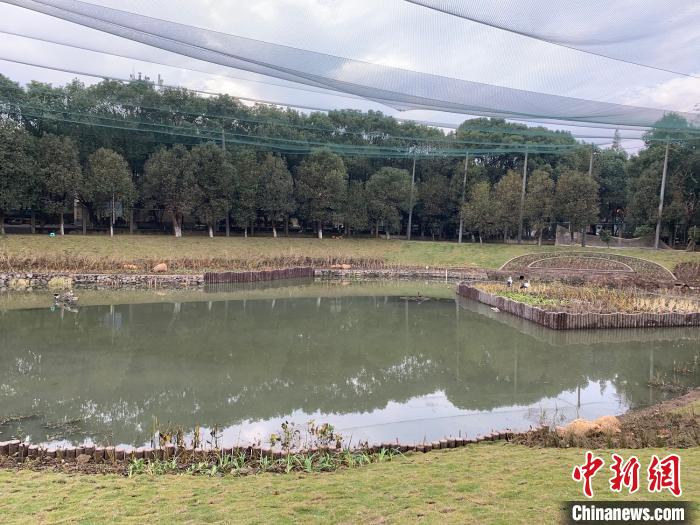
The picture shows the ambulance pond in Wucheng Protection Management Station of Poyang Lake National Nature Reserve Administration. Photo by Li Yunhan
[Dancing with the Yangtze River Economic Belt and Seeing High-quality Development] The "bird keeper" on the Poyang Lake: ten years of protection is only the "last home" for migratory birds.
Zhongxin. com, Yongxiu, Jiangxi Province, November 19 th Title: "Bird Guardian" on the Poyang Lake: Ten years of protection is only the "last home" for migratory birds.
Author Li Yunhan Peng Jingru Lang Jiahui
"Keeping the last home for migratory birds makes me feel very fulfilled." Shu Guolei, the stationmaster of Wucheng Protection and Management Station of Poyang Lake National Nature Reserve Administration (hereinafter referred to as "Wucheng Station of Poyang Lake Reserve"), has been working in Poyang Lake for nearly ten years and is also the "guardian" of migratory birds in this water area.
Poyang Lake, located in the north of Jiangxi Province and the south bank of the middle and lower reaches of the Yangtze River, is the largest freshwater lake in China, an international important wetland and the largest wintering migratory bird habitat in Asia. White-naped cranes, 80% oriental storks and 98% white cranes, which account for 70% of the global population, spend the winter here.
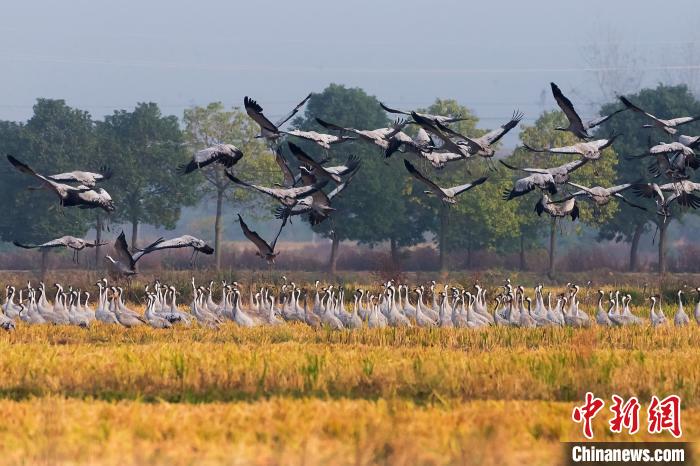
The picture shows migratory birds along Poyang Lake. Photo by Yang Chun
In the process of wintering, some migratory birds will encounter "accidents". When migratory birds encounter accidents, Shu Guolei assumes the responsibility of rescue.
"This is just called ‘ Kaka ’ , this is just called ‘ Frozen ’ They were all sent here to help after being injured. " According to Shu Guolei, there are two injured oriental storks in the rescue pond in Wucheng Station of Poyang Lake Reserve. "Kaka" was caught in the throat by fish during foraging, while "freezing" was that one foot was frozen in the snow and ice weather, and both were sent to help because they could not survive on their own.
“‘ Kaka ’ When it was discovered, it was very weak. If we don’t rescue it, it will definitely not survive. " When talking about the situation when Kaka was discovered, Shu Guolei still had a lingering fear. At present, "Kaka" is recovering well and will be released in a period of time.
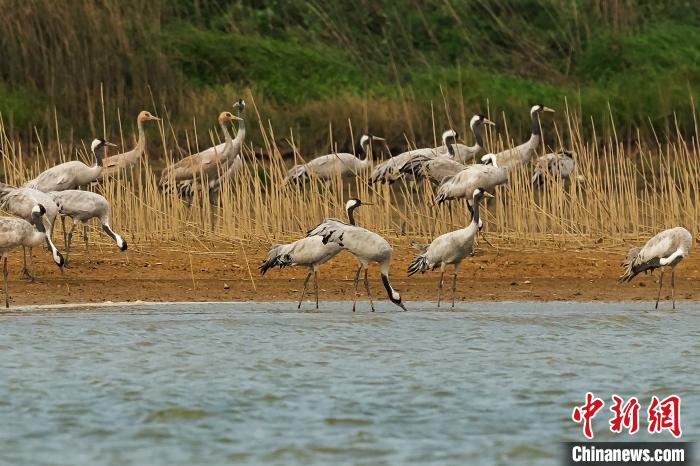
The picture shows migratory birds on the banks of Poyang Lake resting and foraging. Photo by Yang Chun
Shu Guolei said that 60 or 70 migratory birds are "recovering" here every year. Once the two conditions of "eating independently" and "flying independently" are met, it means that the migratory birds have recovered, and Shu Guolei will immediately arrange for the migratory birds to be "discharged" and released.
"My job is to carry out daily patrols and crack down on illegal hunting." Shu Guolei told the reporter of Zhongxin. com that migratory birds will be monitored regularly in the station. At the same time, collect hunting tools, dismantle Skynet, and control the hunting of migratory birds from the source. In addition, a wetland compensation mechanism has been established to mobilize surrounding villagers to carry out migratory bird protection work together.
Shu Guolei finished his daily work in the past ten years in a few words, but little is known about the hardships.
"Sometimes you can’t go home for half a month. Children have to look at photos on the wall to recognize which one their father is." Shu Guolei admits that his children are still young, and it is time to accompany and educate them, but when they are busy, they will not take care of their families.
Under the leadership of Shu Guolei, the surrounding villagers also regard migratory birds as friends. According to Shu Guolei’s memory, a villager once contracted a 1,000-mu pond to breed lobsters. At first, six or seven swans lived in the pond, and swans fed on aquatic plants that raised lobsters, which would cause certain losses to farmers. However, instead of driving away migratory birds, the villager specially planned 50 mu of land for swans to inhabit. Gradually, there were six or seven hundred swans living in his pond. In the end, the villager didn’t drive away the migratory birds.
"Protecting migratory birds is ‘ The predecessors planted trees, while the descendants enjoyed the cool ’ We are now guarding the homes of migratory birds, which is also beneficial to future generations. " When Shu Guolei talked about his work in recent years, he felt very proud. He bluntly said that even the work of patrolling migratory birds every day made him feel very fulfilled.