CCTV News:According to the latest data released by the People’s Bank of China, at the end of March, the balance of China’s broad money, also known as M2, exceeded 300 trillion yuan. According to the total amount of money of 300 trillion yuan, some people think that this is the result of China’s currency over-issuance, which may lead to inflation in the future. So, what is the fact? We interviewed the chief economists of many institutions, and let’s take a look at their views first.
Dong Ximiao, chief researcher of Zhaolian, said: "There is no problem of currency overshoot in China. Some people still equate money with cash, and simply think that money is issued by the central bank and is a debt of the central bank, which is not accurate. In China, the direct impact on the money supply is mainly the credit supply of commercial banks, not the cash supply of the central bank. "

Wen Bin, chief economist of China Minsheng Bank, said: "We always adhere to a prudent monetary policy and do not flood with water. Therefore, in recent years, we have seen that the overall money supply matches the needs of economic growth and the needs of the real economy."
It depends on whether the currency is "overshot", but also on the inflation rate, that is, on the price level. In the past 10 years, China’s consumer price index has been hovering at 2%— 3%, especially in the last three years, has been below 2%. Judging from the future trend, it will not cause inflation.

Wang Qing, chief macro analyst of Oriental Jincheng, said: "Although the M2 of 300 trillion yuan is very large, it will not cause high inflation in China. One of the key points of our macro-control is to control the main gate of money and prevent excessive currency from causing high inflation. In the context of the current low price level, the focus of the policy is to emphasize the control of the growth rate of M2 near the sum of the actual economic growth rate and the target price increase, and promote a moderate recovery of the price level. "

Lian Ping, chairman of the Forum of China’s Chief Economists, said: "This kind of inflation has obviously not appeared in China, and our current price level is still relatively low. At present, the consumer price index (CPI) is generally improving, and it is estimated that the whole year may be just over 1%, which is significantly lower than the target of 3% set by the state. "
What is broad money?
In the interview, the chief economists of these institutions agreed that China’s currency was not overshot and flooded. So what does this 300 trillion yuan scale mean? What is the impact on China’s economy?
To understand this 300 trillion yuan, we must first know what broad money (M2) is. Simply put, broad money includes cash in circulation, demand deposits, time deposits and savings deposits of residents and enterprises, and refers to the money supply of a country or region. Among them, all kinds of deposits of residents and enterprises account for the vast majority.

In broad money, deposits account for the bulk, and deposits and loans are closely related. Behind the increase in the total amount of money is the expansion of economic scale.
Wang Qing, chief macro analyst of Oriental Jincheng, said: "For example, if an enterprise obtains a loan from a bank, it may use this loan to operate, which will eventually turn into employee income and deposit. If it invests, the money will be converted into deposits of other enterprises, that is, enterprises that sell equipment and materials. Therefore, the increase of various types of loans will promote the simultaneous rise of deposits. "

Wen Bin, chief economist of China Minsheng Bank, said: "Therefore, in the whole process of credit supply and credit expansion, it will certainly support the rapid development of the real economy and also lead to the expansion of the total amount of money. This also reflects that our entire economy is more focused on the real economy. "
In the final analysis, the increase of money supply corresponds to economic development. In recent years, China has been one of the countries with rapid economic growth in the world. China’s total economic output has reached 126 trillion yuan, and the reasonable growth of money supply has provided solid support for economic development.

Dong Ximiao, chief researcher of Zhaolian, said: "The broad money (M2) has exceeded 300 trillion yuan, but M2 has broken through a certain integer point on the basis of maintaining a reasonable growth rate, which does not mean that monetary policy has turned, nor is there too much money supply, so there is no need to pay too much attention."
How to make good use of this 300 trillion yuan?
The total amount of money of 300 trillion yuan has provided great support for the development of the real economy. In the future, how can we make better use of the new money supply and improve the quality and efficiency of the use of existing money? The unanimous answer is to support the key areas and weak links of the real economy.
Wang Qing, chief macro analyst of Oriental Jincheng, said: "To focus the new money supply or new loans on key links and weak areas of the national economy such as technological innovation, green development, small and micro enterprises, we can see that the central bank has recently set up 500 billion yuan of technological innovation and technological transformation refinancing, which is to guide commercial banks to flow more funds to these areas."
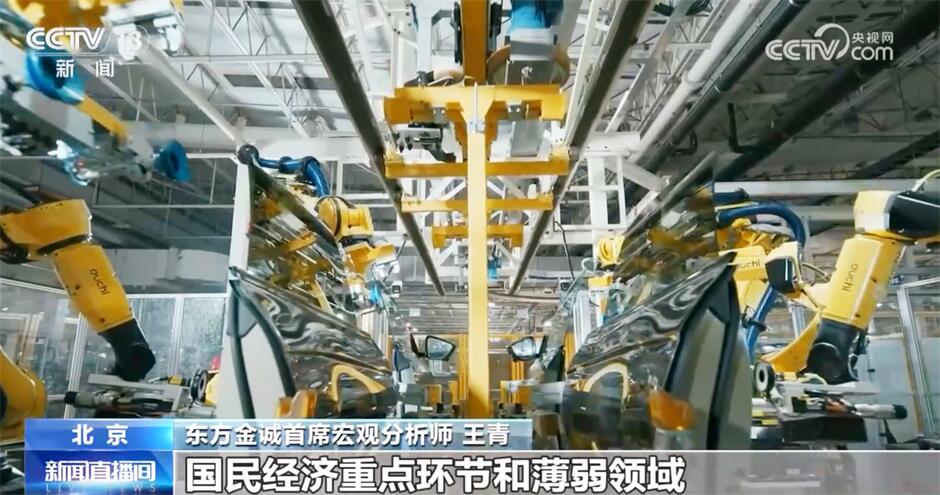
Ming Ming, chief economist of CITIC Securities, said: "M2 will play a role in supporting economic growth through various assets. We can see that the growth rate of loans related to new quality productivity, such as small and micro, green and science and technology, is relatively high, and the balance of inclusive loans continues to rise, with a year-on-year growth rate of more than 25%, which is relatively high. "

Experts said that it was true that some loans were inefficient and precipitated in the past. Next, we should further optimize the credit structure under the guidance of structural monetary policy to better support and serve the real economy.

Wen Bin, chief economist of China Minsheng Bank, said: "To further revitalize credit resources, especially for some real estate and financing platform credit resources in the past, we can further optimize the credit delivery structure and invest this resource in key areas and weak links in national economic development, so as to better improve the quality and efficiency of credit."