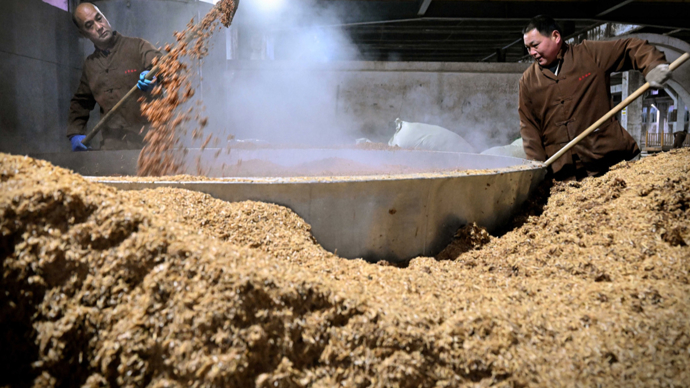
In our food, a lot of delicious food is related to fermentation, which is created with the help of microorganisms. Bread, steamed bread, etc. are inseparable from the fermentation process, and microorganisms are involved.
This has formed a huge fermentation empire around us, and because of the participation of human beings, these fermented foods have shown a colorful state.
Through the in-depth combing of these fermented foods, we can also get a glimpse of the development of our own human culture, and the history of fermented foods, to some extent, is the history of human culture itself. This article is taken from Anthropology of Fermentation Culture: Viewing Human Society from the Perspective of Microbes.
There are traces in murals more than 3 thousand years ago
Archaeologists believe that both humans living in the cold Siberian glacier area and the Amazon rainforest in South America evolved from Homo sapiens. About 200,000 years ago, Homo sapiens who appeared on the African continent mostly lived by hunting and gathering. In this way, they gradually moved towards Eurasia, and created Mesopotamia civilization in the eastern Mediterranean about 6,000 years ago and ancient Egypt civilization about 7,000 years ago.
In ancient Egyptian murals more than 3,000 years ago, there were scenes depicting mashing grapes to make wine, and it was also found that the food was preserved by salting fish. In this way, the origin of fermentation can be traced back to the formation of the oldest known civilization, or even earlier (perhaps the ancient ancestors of human beings had already had a party drinking homemade wine).
Maybe there will be such a story then. Our ancestors piled the newly harvested wheat in the warehouse, only to find that it was flooded and soaked in water, and it was already bubbling when it was found. At this time, if the person found ignores it in order to avoid accountability, the warehouse will be filled with the aroma of beer after a while; If a thrifty housekeeper finds out, he may fish out the wheat, drain it and smoke it on the fire. After a while, the aroma of bread will drift away.
Perhaps, after our ancestors left the juice squeezed from grapes for a period of time, they gradually smelled some subtle sweet smells, and then found that the sweetness gradually disappeared and was replaced by some slightly sour and mellow unique flavors. This may be the most primitive wine-making process. Next, I will explain these fermentation phenomena one by one.
After wheat germinates, the sugar content in wheat grains will increase under the action of plant enzymes. These sugars are used by microorganisms such as yeast (budding yeast) to produce alcohol and bubbling carbon dioxide gas. That is to say, the dense foam and alcohol in beer are not added by the brewery in the production process, but by microorganisms.

As for the process of making bread, I use Indian pancakes and Indian naan, which are well understood by everyone, as an example. Both are popular staple foods in Indian cuisine. Indian pancakes are thin and a little hard after baking. Indian naan is also made of flour, but it is soft and sweet after baking. This is because Indian naan is fermented by yeast during the production process, which makes the dough release carbon dioxide gas during the baking process, which is why we always see a lot of bulges in naan. Similarly, the soft and sweet bread that can be made simply by heating is also the credit of yeast.
It can be said to be a turning point of human civilization.
What about wine? The brewing of wine is also a process of yeast fermentation. There are many wild yeasts attached to the skin of grapes. When the grapes ripen and fall to the ground, the fruit will break, and the yeasts attached to the skin will take advantage of the situation to absorb the rich sugar in the grape fruit. At this time, fermentation will begin (in principle, it is the same as beer brewing). As for why grape juice is sweet, but wine tastes mellow and has a unique aroma, this is because the sugar in grape fruit is used by yeast to brew delicious alcoholic drinks for us during fermentation.
However, this delicious brewing process must be carried out in a completely closed environment. Alcohol and other substances produced by yeast fermentation keep other putrefying bacteria away, which is why wine is less prone to putrefaction than grape juice. Who can refuse grape wine that can be preserved for a long time and become more mellow and fragrant?
Our ancestors must have thought, "Although we don’t know what happened, we seem to have done the right thing at the right time. This delicious food may be given to us by God! Great! " So these fermentation techniques are summarized into recipes that can be learned by adults by cooking people’s hands, and you can always smell bread or wine in ancient towns …
Here, it can be said that it is the turning point of human civilization!
Homo sapiens-intelligent human beings. They discover the life activities of microorganisms invisible to the naked eye from the appearance of food changes, and use it to enrich our human culture and life. Didn’t human civilization develop in fermentation? Our wise ancestors can communicate with microorganisms invisible to the naked eye, which is a great progress of mankind!
Monkeys and zebras munching on ripe fruits don’t think about "making fermented food with their limbs or horseshoes". If I want to think about the philosophical proposition of "what is man", I, as a fermentation designer, will answer "I want to ferment, therefore I am". But don’t forget, "when you are drunk, everything goes wrong."
The encounter between human and mold
In Japan’s oldest chronicle "Ancient Stories" (compiled in 712), there was a story of "Su Zhan Ming Zun got the Hachida serpent drunk and took the opportunity to kill the serpent and marry Qi Daotian Ji". This proves that at least at that time, the Japanese had mastered the technology of making wine with rice or fruit. Historians believe that the Japanese learned to ferment about 1300 years ago.
Among them, there is a famous poem in "Spreading the Country’s Customs" (edited in 713-715), which is simply translated as follows: "The rice offered to our ancestors was fermented by mildew, and everyone drank and had fun together. It was a wonderful party!"
Among them, "moldy rice" and "brewed wine" are the key messages. How are these seemingly incomprehensible two points connected?
"Moldy … doesn’t it mean that the food is rotten?"
According to the usual literal meaning, it is true. However, there is a tradition of "fermentation with mold" in East Asia, the most representative of which is Japan’s "fermentation technology using mold". The western (Mediterranean) region mentioned above uses yeast to make wine, while in our east, the brewing technology of "using mold fermentation" is the mainstream. Just like the Japanese team’s "Judo" in the Olympic Games, this brewing technology is Japan’s "national quintessence".
What on earth is this traditional skill? I’ll explain it to you right away.
The microorganisms that turn the placed rice into wine are actually called "Aspergillus japonicus", which inhabit rice fields and are special "fermentation molds". Japanese usually write "Aspergillus", which is a very important part of Japanese food culture.
Before explaining Aspergillus japonicus, let’s popularize the concept of mold.
Mould, the largest in microorganisms, belongs to the category of "fungi" with high degree of evolution. Morphologically, they have "hyphae" equivalent to plant roots and "spores" equivalent to plant leaves and stems.
Although molds are quite similar to plants in morphology, they can’t carry out photosynthesis like plants. They are heterotrophic creatures like animals. If you walk in the Woods, you may see that rotten fruits, animal droppings, and insect remains are covered with furry things, that is mold.
Mould penetrates its long hyphae into nutrient-rich nutrients, and sips off nutrients to help its spores cover "food" as much as possible. When the spores mature, they will release "seeds" from the front end, and the "seeds" will fly in the air, on the ground, or on the surface of plants … They first go into hibernation, and then when the time is ripe, they will attach to food, and then start a new round of growth.
In nature, there are many molds that survive by decomposing the corpses of other organisms like this. They play the role of "decomposers" and are an important part of the natural ecological cycle (of course, there are also malicious roles in molds that kill other living organisms and decompose them to extract the required nutrients).
Mould is the bridge between animals and plants visible to the naked eye and invisible microorganisms.
They decompose thick plant cell walls and complex living structures that ordinary bacteria and other microorganisms cannot decompose into small molecular compounds for small microorganisms to use.
Mold can turn rice into fruit.
Now we can get down to business. Let’s take a look at what happened in "moldy rice".
Aspergillus japonicus, who originally lived in rice fields, likes rice best. But like us humans, they think raw rice is too hard to eat and must be steamed before eating. The "wet rice" recorded in "Sowing the Country’s Customs" is "steamed rice with moisture". This is the favorite of Japanese Aspergillus, which is as delicious as the draft beer that Tokyo office workers "drank under Xinqiao shed in the sunset of early summer evening" after work.
It is at this moment that Aspergillus japonicus, which is adsorbed on the moist rice, quietly puts its mycelium into the rice, and they swim in it like the roots of plants, enjoying the sweet rice and feasting. At this time, starch, the main component of rice, is broken down into small molecular sugars to provide energy for Aspergillus.
Aspergillus japonicus grows rapidly under the energy obtained by decomposing rice, and soon its spores form a white leaf-like structure, covering the whole rice tightly. This phenomenon is equivalent to the hairy spore layer covered by feces and insect remains that we will see in the forest (sorry I gave a slightly disgusting example).
At this time, if you pull open the spore layer and look at the rice grain, all the starch in the rice grain has been broken down into sugar. In other words, the rice at this time is as sweet as grapes. How amazing! Mold can turn rice into fruit!
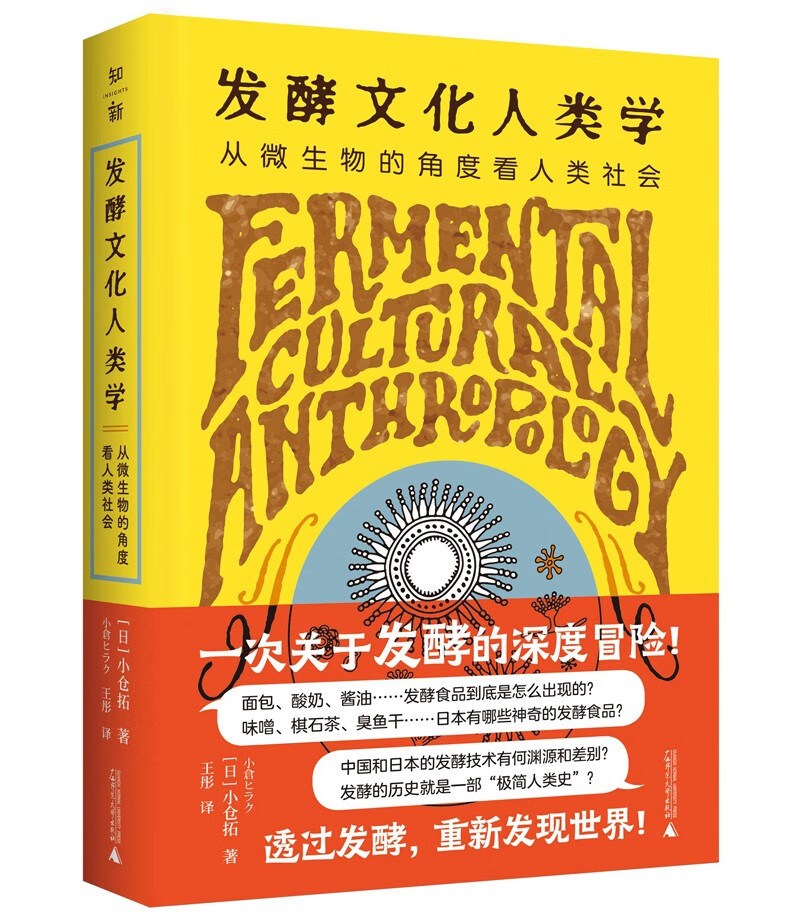
Anthropology of Fermentation Culture: Looking at Human Society from the Perspective of Microbes
[Japan] Kokura Takuya
Translated by Wang Tong
Guangxi Normal University Press
Editor-in-Chief: Gu Xuewen
Text editor: Wang Yi
Author: [Japan] Kokura Tuo
Source: Xinhua News Agency